Advanced Location Targeting

2022-06-02_12-12-06.png

Advanced Location Targeting is currently available exclusively in the U.S., but we’re just getting started. Stay tuned for updates as we bring Advanced Location Targeting to more regions soon!

Here are the requirements for applying advanced location targeting to your campaigns within the Audience Explorer:

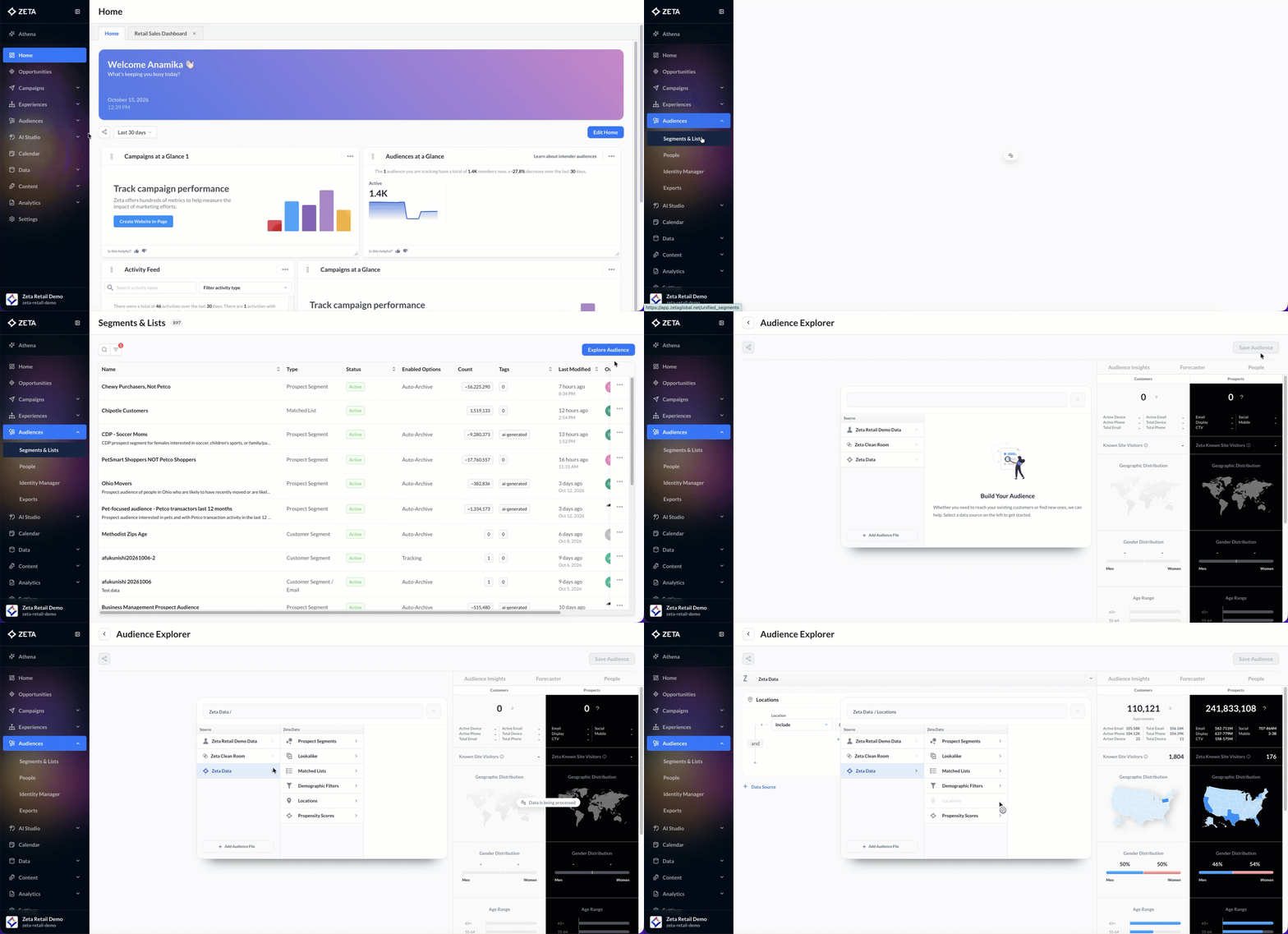
1. From the menu on the left, select Audiences > Segments & Lists. Click on Explore Audience.

2. Select Zeta Data > Locations and choose the property(s) of your preference.
2026-10-15_12-40-48 (1).gif

3. Click on Choose Multiple Locations.
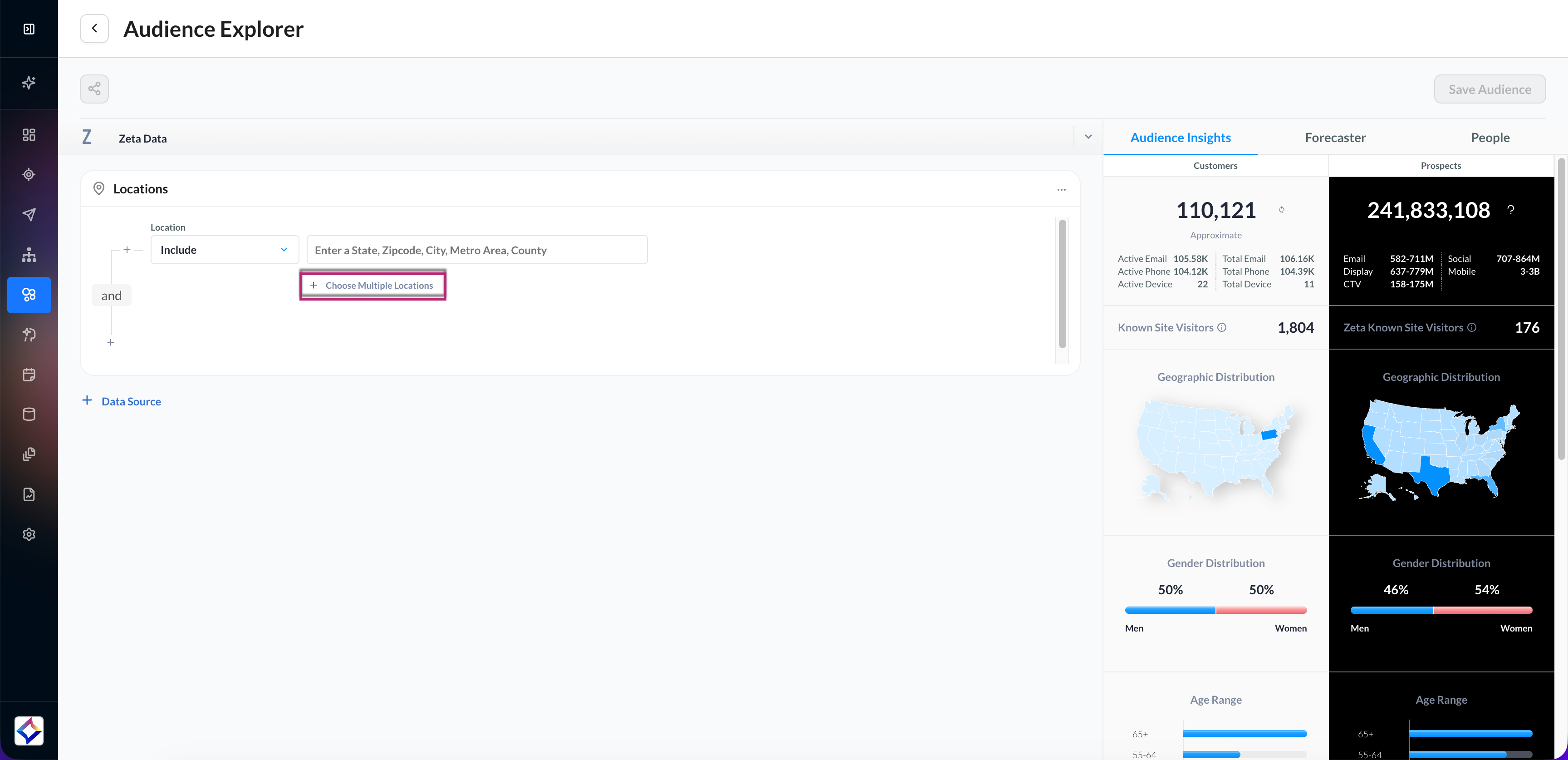
image-20261015-071218.png

You can segment audiences based on location information such as city, state, zip code, and latitude/longitude. You can choose to include as well as exclude specific locations for segmentation.

image-20230911-051233.png

4. Within the screen that appears, you can:

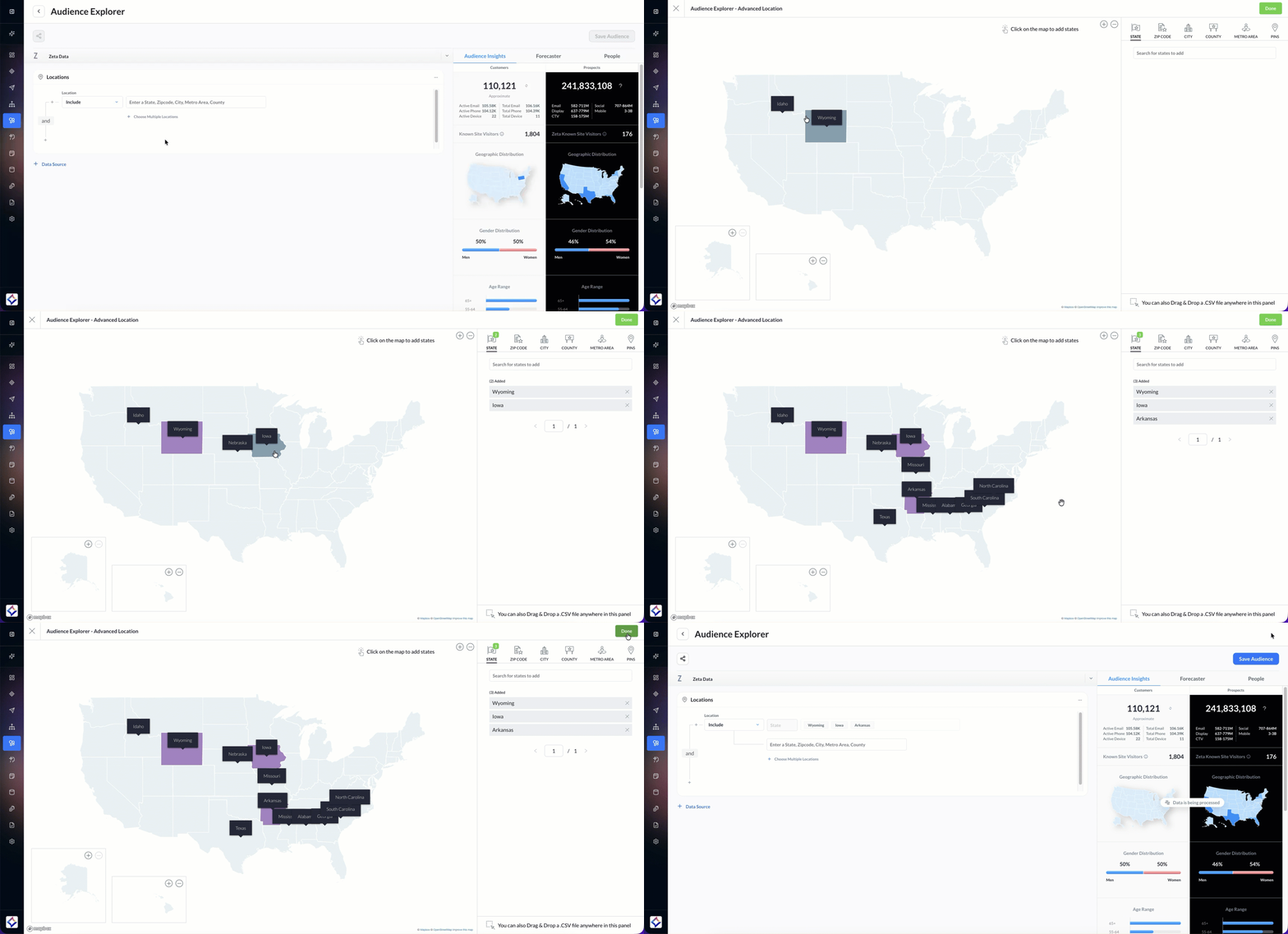
  • Select locations on the map

2026-10-15_12-44-02 (1)-20261015-071430.gif
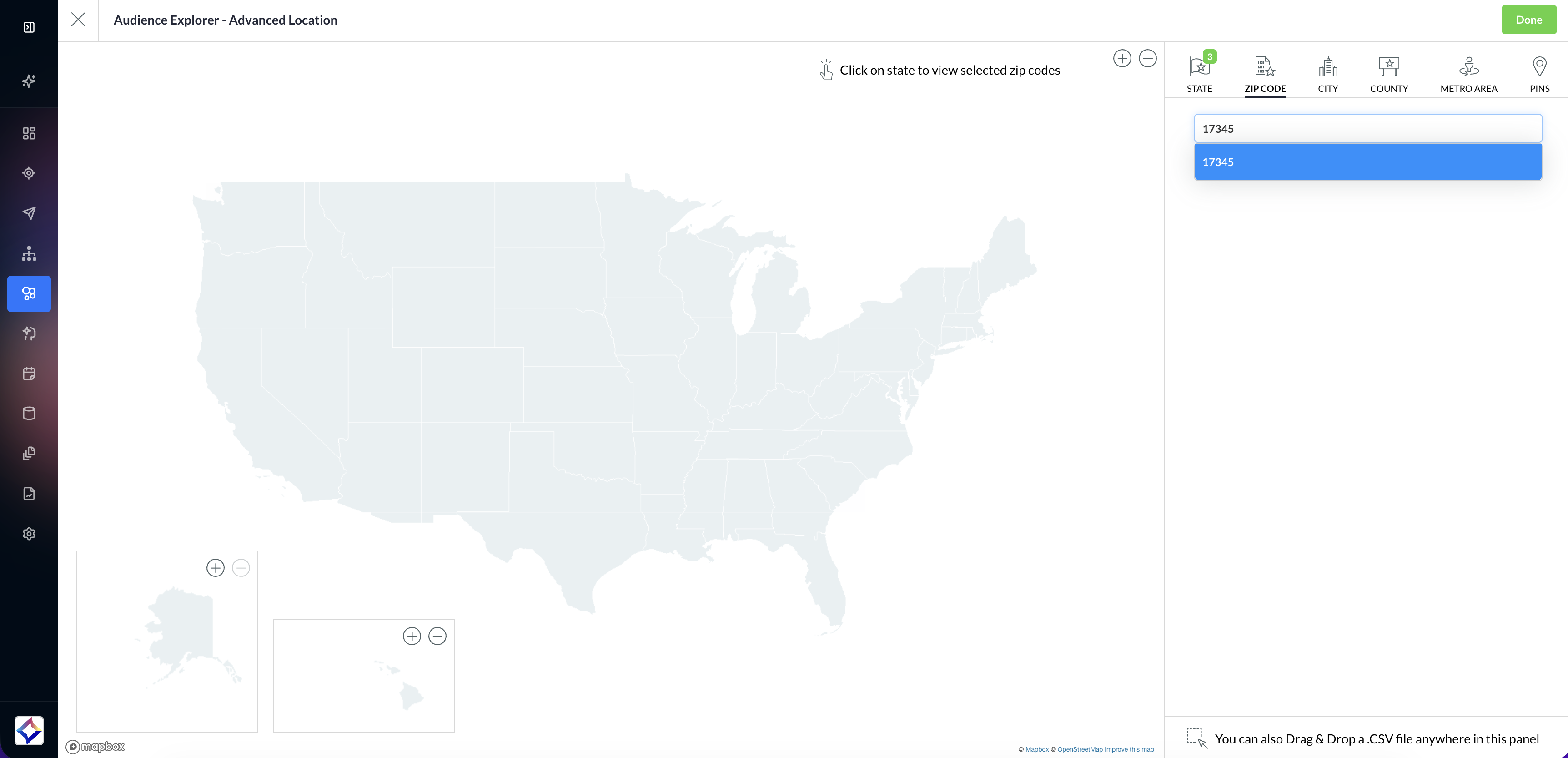
  • Select 5-digit zip codes

image-20261015-071537.png
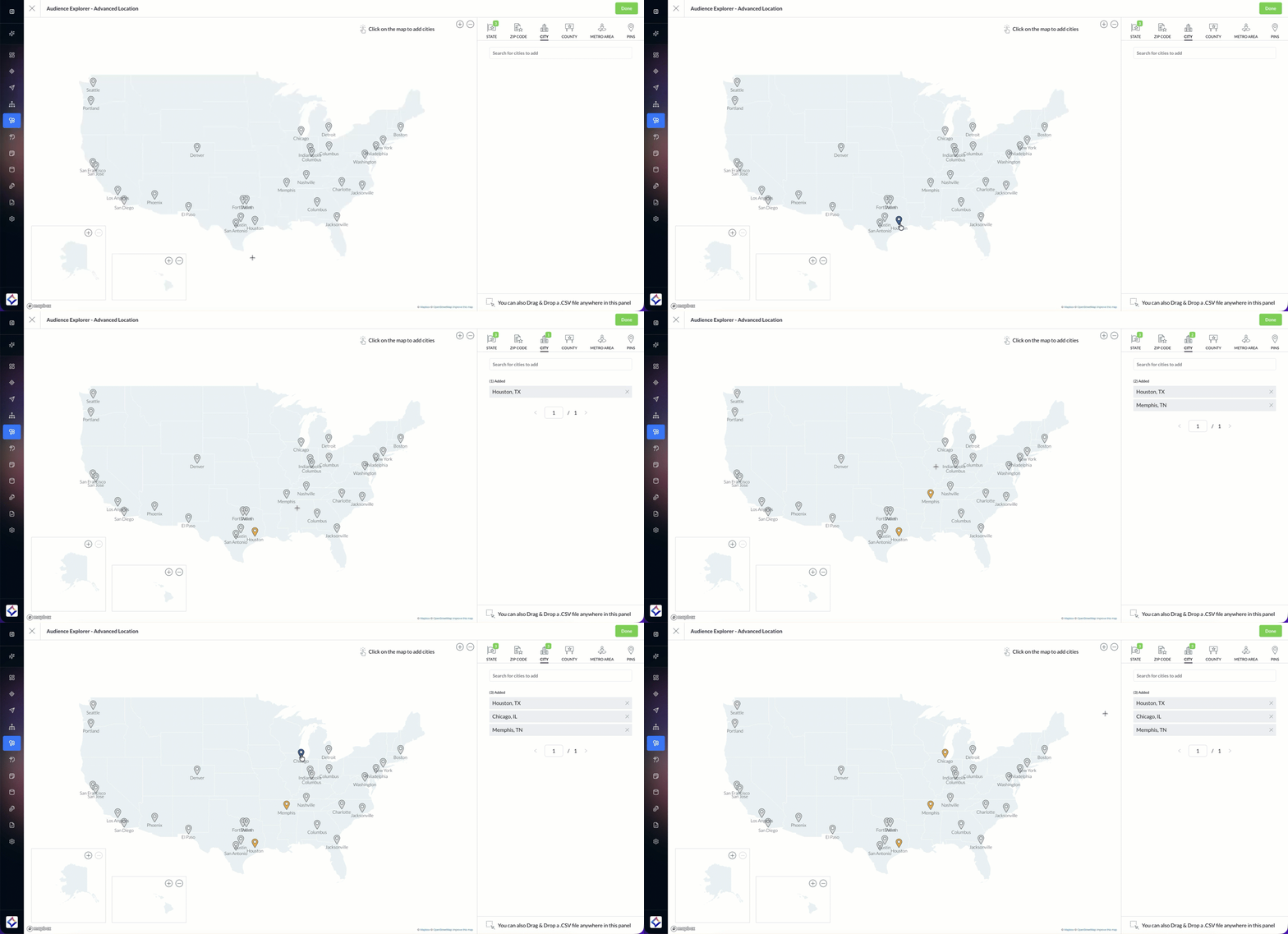
  • Select cities from the pins on the map
2026-10-15_12-46-12 (1)-20261015-071626.gif
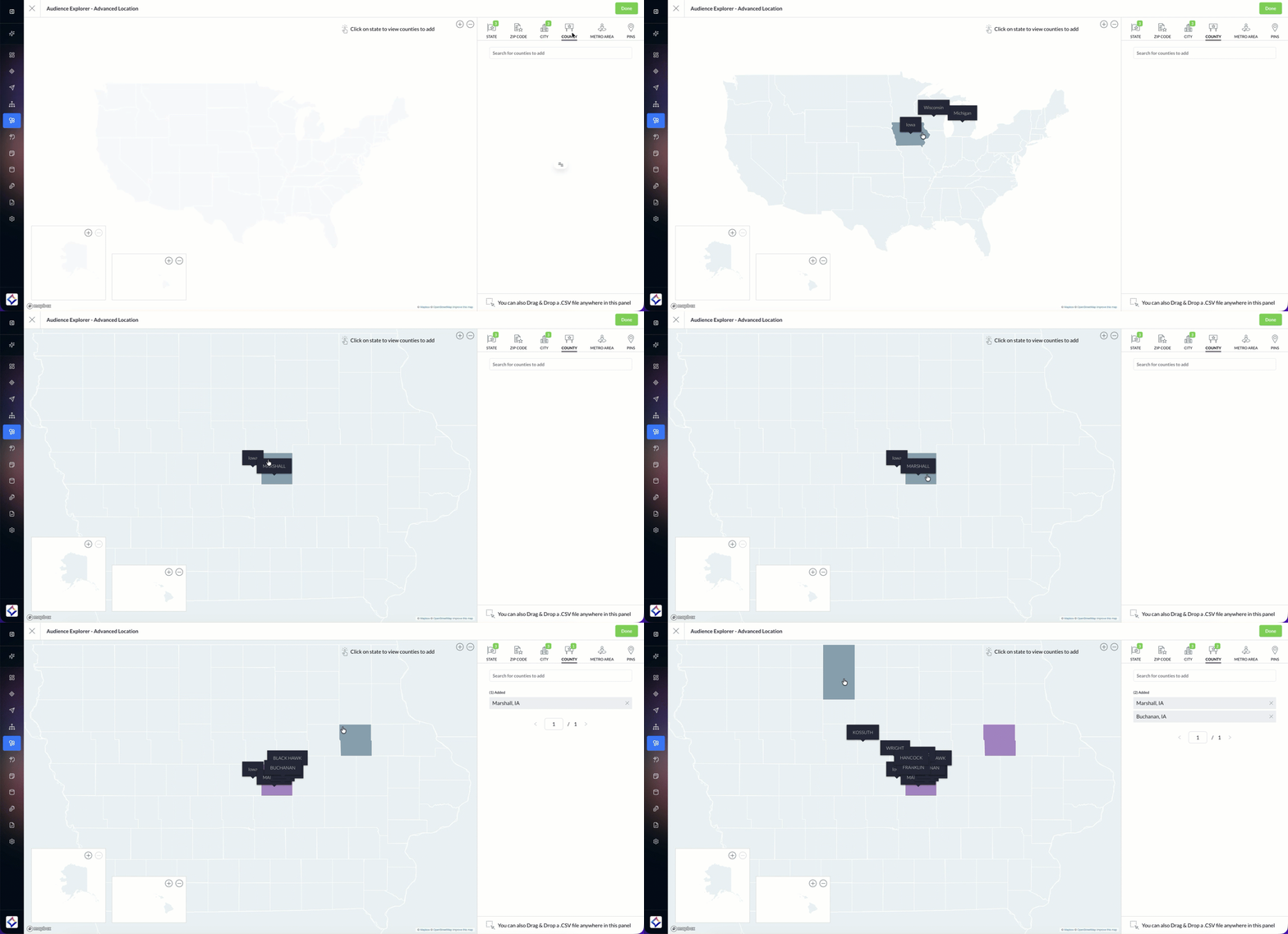
  • Select counties

2026-10-15_12-47-13 (1)-20261015-071738.gif
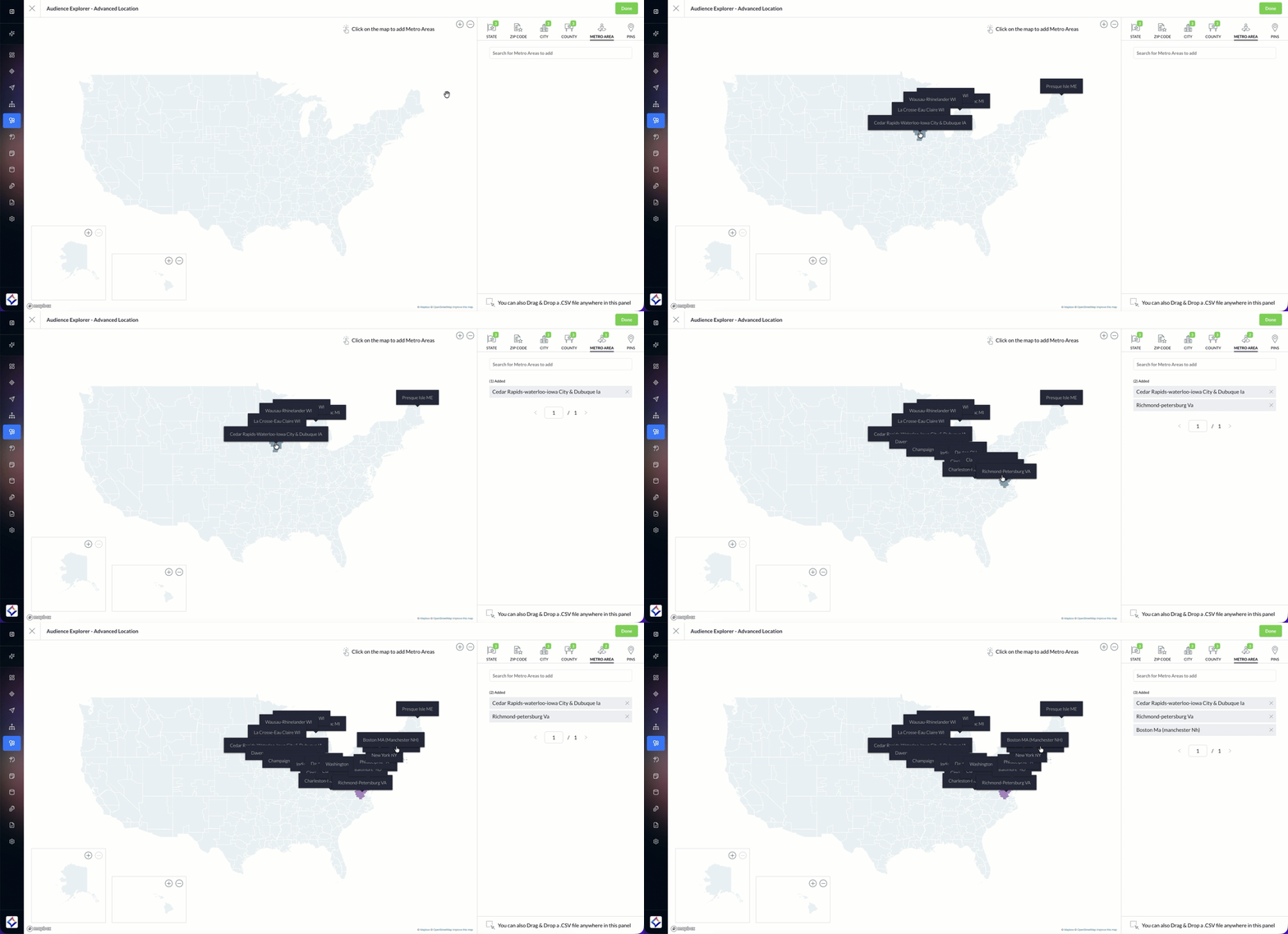
  • Select metro areas

2026-10-15_12-48-12 (1)-20261015-071830.gif
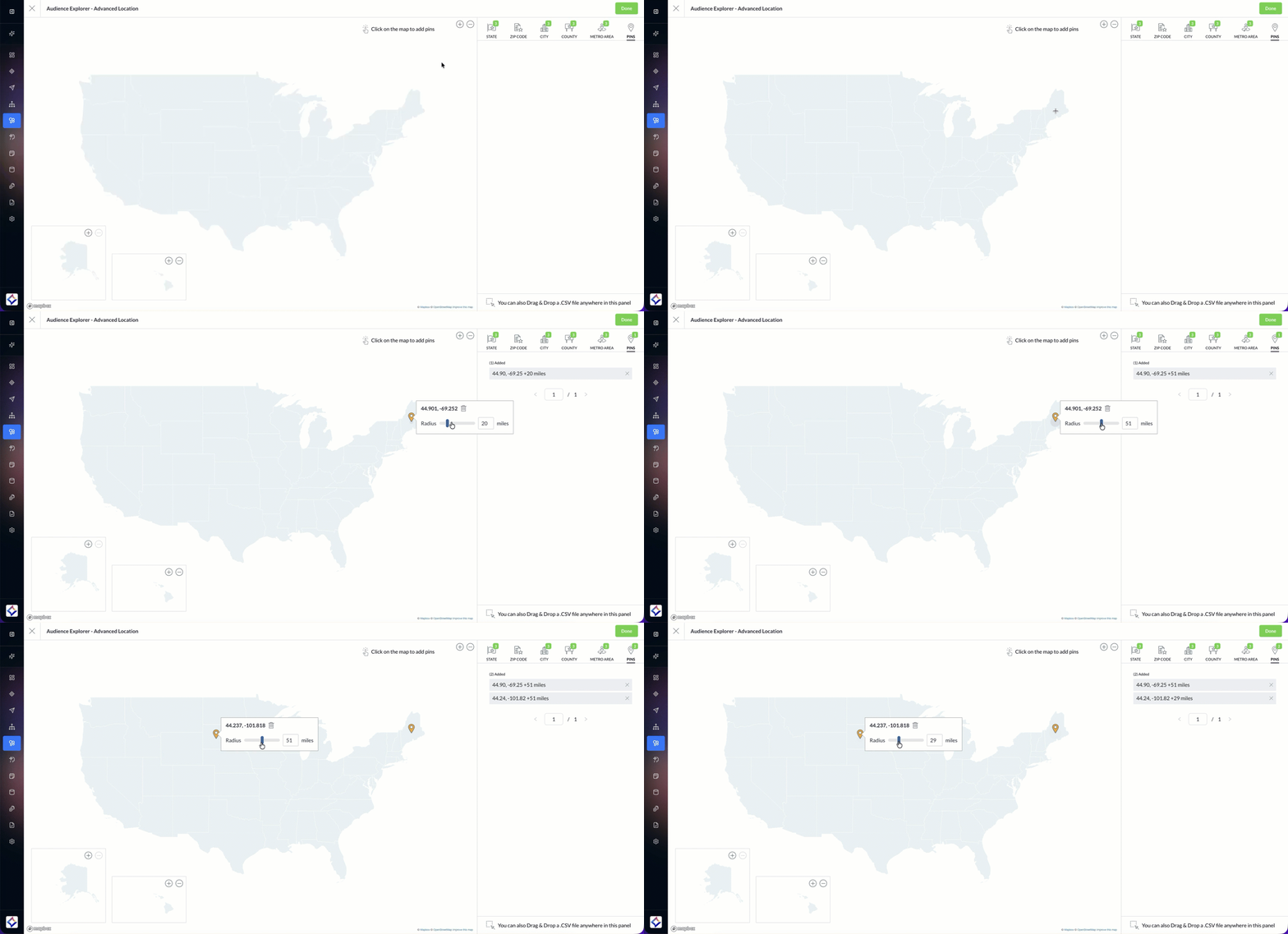
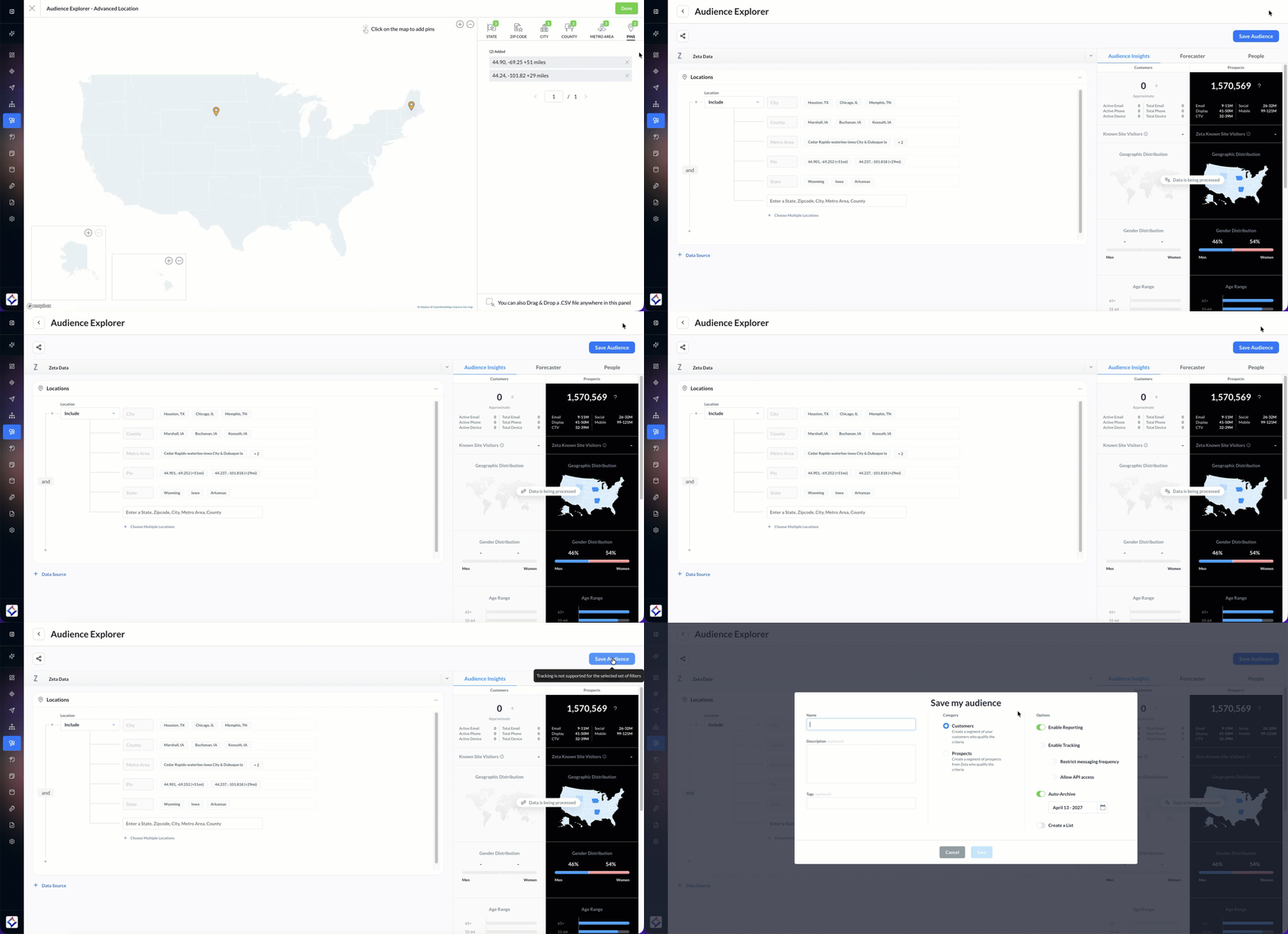
  • Select pins

2026-10-15_13-16-35 (1)-20261015-074659.gif

5. Once all of the targeting is set, click on Done.
2026-10-15_13-17-28 (1)-20261015-074741.gif

Based on the Targeting that you apply, you will see the Audience Insights on the right.


Target in Bulk

1. On the Audience Explorer - Advanced Location screen, click on Drag & Drop a .CSV file anywhere in this panel at the bottom right.
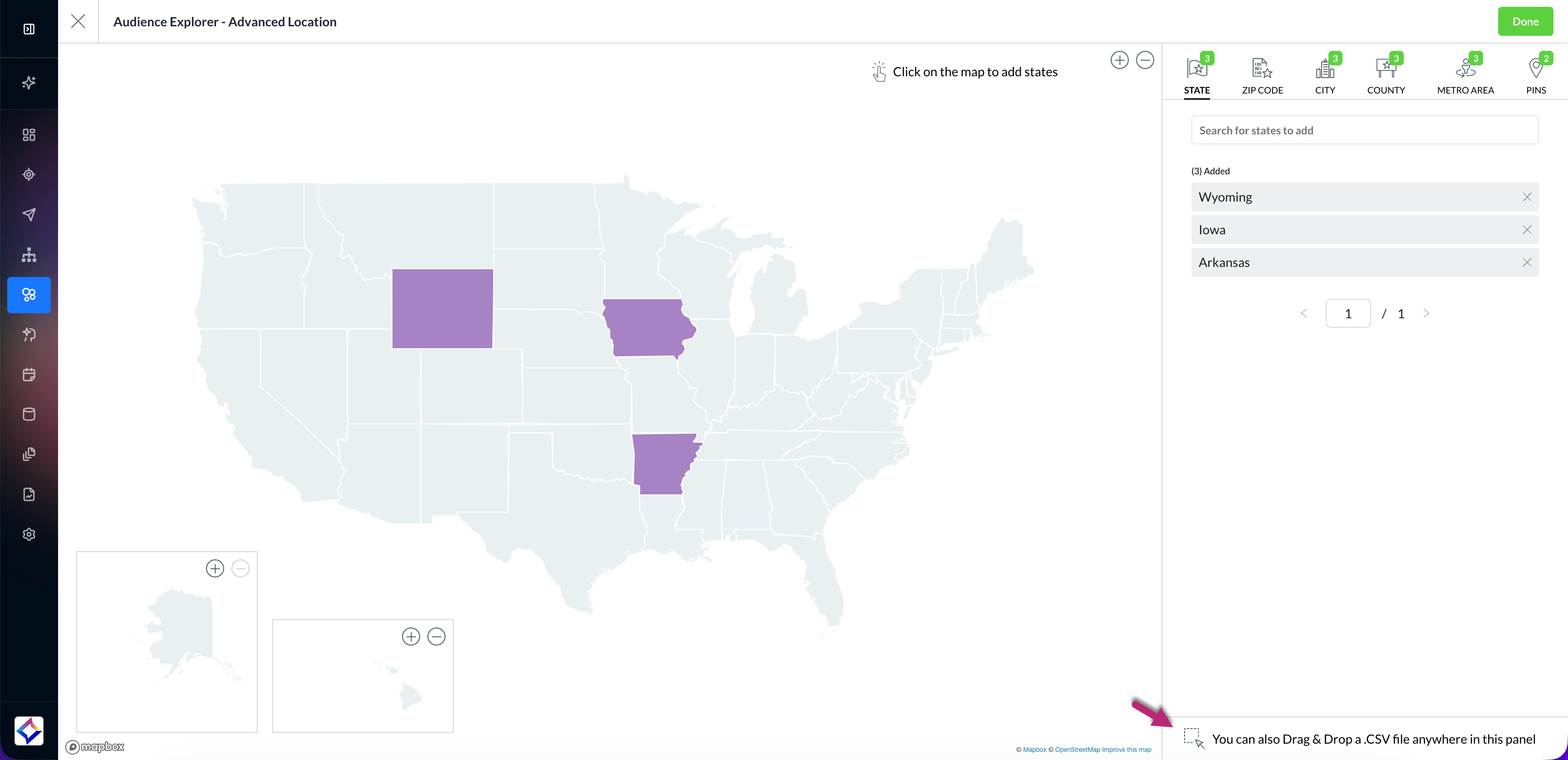
image-20261015-075025.png

2. You can upload a number of different geographic markers (zip, county, and more)

  • Once the File passes validation, you will be able to see how many Match Locations were added based on the locations listed within the CSV file.

CSV File Format/ Requirements

Files should be CSV files with one or more columns that specify the location.

CSV Column requirements differ depending on the location type (Note that there are no restrictions on filename, other than the extension. The following other requirements will be in place for CSVs:

  • US States

    • Header - NONE

    • Value Format - Either a full state name (case-insensitive), or the USPS two-letter representation of a US State, case-insensitive, e.g. ca, Fl, Ohio, UTAH, or NY

  • US ZIP Codes

    • Header - NONE

    • Value Format -

      • A valid 5-digit ZIP, e.g., 93277

      • Radius should be an integer between 0 and 100, e.g., 10

      • Sample file

        • Screen Shot 2021-09-30 at 10.41.16 AM.png
  • US Cities

    • Header - NONE

    • Value Format - A string representation of a city and the USPS two-letter representation of a US State, split into 2 cells

  • US Counties

    • Header - NONE

    • Value Format - A string representation of the US county and the USPS two-letter representation of a US State, separated by a comma, case-insensitive. Note that whitespace characters should be removed in non-CSV contexts such that a space after a comma is allowed for bulk import, e.g., Tulare, CA or King, WA.

  • Latitude/Longitude Locations

    • Header - latitude, longitude, radius

    • Value Format -  string representation of the latitude and longitude point. Radius should be a number in miles between 1 and 1000. 

      • Latitude is a number preceded by a sign character. A plus sign (+) denotes the northern hemisphere or the equator, and a minus sign (-) denotes the southern hemisphere.

      • Longitude is a number preceded by a sign character. A plus sign (+) denotes east longitude of the prime meridian, and a minus sign (-) denotes west longitude or the 180° meridian (opposite of the prime meridian)

        • Sample CSV File Below

          lat_1.PNG

zip radius.csvdma-list.xlsx